|
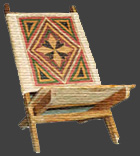
the wooden chair with leather backrest
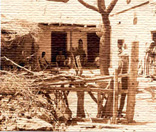
the craftsmen's habitat
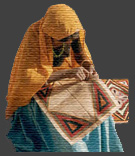
embroidery in progress
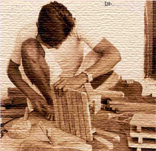
the final touches
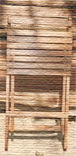
another view of the chair
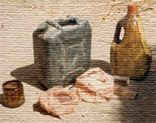
raw materials used for the finishing process
|
The furniture craft sector of Tiloniya produces the typical two piece knock-down
chair, with exquisitely embroidered leather backrests, and matching stools. SWRC (Social Welfare Research Centre),
a voluntary organisation is actively involved in organising, promoting, and marketing of the crafts of Tiloniya.
The furniture of this region involves the carpenters making the basic wooden framework, while other men and women
work on the leather backrest. Though the origin of furniture craft in Tiloniya is quite recent, the embroidery
on leather has been going on for generations, and has now been adapted for furniture. It is the synthesis of these
people involved in the two fields, which has resulted in what today is known as Tiloniya furniture. These people
have been helped in their endeavours by the SWRC.
The Place
Tiloniya village, located between Ajmer and Jaipur, is connected
with Ajmer by bus, auto rickshaw and jeep. The village is seven kilometres off the Ajmer — Delhi highway, approached
by a metal road bifurcating at Patan. Tiloniya also has a railway station which is on the Ajmer — Delhi route,
though only local trains call here.
SWRC has its head office in this village, and it provides a centre for the development of craft in and around Tiloniya.
Furniture craft is actually based in the villages of Harmara and Ladehra, which are 4 and 27 kilometres away from
Tiloniya respectively. Harmara is a small village where a section of the community is involved leather embroidery.
Ladehra, also a small village, is where the woodwork required for the furniture is produced. The finished products
from these two sites are thereafter assembled and sold at SWRC (locally known as the centre), and are not very
expensive.
The People
The woodwork is done mainly by the suthars of Ladehra. This large
joint family was traditionally involved in the village carpentry work and made products like ploughs, chowkis,
doors, jharokhas, etc. A section of this family has diversified into the craft sector, making wooden chairs and
stools.
The leather embroidery is done by the womenfolk of Harmara and other adjacent villages. The finishing and sticking
is done by the men.
These people are traditionally of lower castes, but gradually their status is rising. All of them are involved
in farming and cattle rearing too. They are paid on the basis of the number of pieces they produce in a day. These
people have strong family bonds, and the concept of a joint family is widely accepted. They have strong roots in
their native land, though some of them are lured by the cities’ promise of greener pastures. However, these people
say they are ready to come back if provided with a job and monetary incentives.
There was a phase when plastic and industrial products were in vogue, and the daily livelihood of these craftsmen
were dwindling. However, this scenario is fast changing. With the growing market for craft products, more and more
people are getting involved at the production level, and the prospects are brightening.
The Craft
The furniture craft in Tiloniya has quite a recent origin. The
two piece knock-down chair with embroidered leather backrest is probably the most widely used concept throughout
the craft pockets of India. It is said to have originated from Saharanpur, in Uttar Pradesh. This chair has been
adopted by the craftsmen of various regions, and after local touches and embellishments are added, is sold as a
craft of that area. Variations of this product can be found all over the crafts belts in the country.
The carpenters of Tiloniya make the wooden frame and supply it to the SWRC. They get paid Rs. 155 for every piece
supplied. The productivity per person is 2 — 3 chairs a day. They also make a small stool to go with the chair.
The leather embroidery work is done by the womenfolk, who sit down in groups or individually in their free time
and work tediously to give colour to the leather. Most of the physical work is done by men. They are paid Rs. 185
per piece from the SWRC.
The leather embroidery is done over the patterns copied from a stencil. The colours and motifs are geared to meet
the market demands and are provided by the SWRC.
Raw Material and Tools
As far as the woodwork is concerned, the tools used are the common
carpenters’ hand tools like saws, chisels, hammers, drills, planers etc. The wood used is sagwan (teak), which
is purchased from the markets in Kishangarh. The finish, which is done by applying putty, sanding and finally oil
varnish (spirit, lacquer and chandras), is not up to the mark.
In the leather department, common leather finishing and embroidery tools are used, such as scivers, chisels, scissors,
needles, coloured thread, etc. The leather, initially produced locally, is now being brought in from Delhi and
Kanpur.
Most of the tools are purchased from Kishangarh, Ajmer and Jaipur.
The Market
The marketing in Tiloniya is monopolised by the SWRC. It is sold
at their local showroom, and they take orders from the rest of the country (and abroad) too. This showroom has
a range of handicraft articles including textile, furniture, leather products, etc and is situated in the SWRC
campus itself. The buyers include visitors to Tiloniya, people in and around Ajmer and the craft dealers. The market
is vast and the craftsmen admit their inability to meet demands. There is absolutely no mechanisation in the field,
keeping productivity low. SWRC’s answer to that is they want to generate more employment to meet demands.
Problems and Suggestions
There is a lack of understanding of the methods of seasoning
wood, due to which, there is a high number of rejections, and the results not very precise. The finish quality
requires great improvement.
The carpenters expressed a desire to make other items of furniture, but the time used in the period of learning
has very low productivity, and therefore generates low revenue. Since there is nobody to support them, there is
no initiative in this direction.
Continuing the way they are, these craftsmen are becoming more and more like machines. They need a greater variety
in design and an approach which understands their problems and tries to revive their traditions, thereby uplifting
their community. |