|
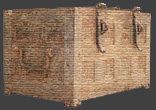
a metal peti (trunk)
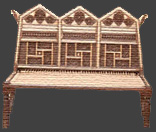
wooden three seater
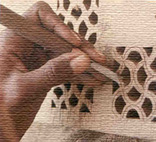
a wooden jali being made
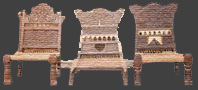
various types of chairs
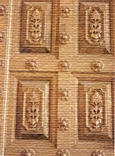
brass casting for ornamentation
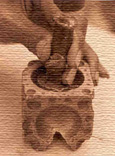
brass caps for chairs under construction
|
Shekhavati Handicrafts is the company which largely monopolises the supply
of the craft products in this region. It is owned by a family living in Ramgarh, a village 15 kilometres by road
from Churu. The Johris have employed about 200 craftsmen within Ramgarh, and have around 300 others spread around
Churu, Lachchmangarh, Sardarshahr, Loharu, etc working for them. Of these, only about 15 craftsmen are natives
of Ramgarh. The rest have come from neighbouring areas to seek employment. Of the craftsmen working in Ramgarh,
20 are highly skilled, and are responsible for training the others.
The Place
The Shekhavati region consists mainly of the Sikar, Churu and
Jhunjhunu districts. This region has dry and extreme climatic conditions, and the annual rainfall does not exceed
38—45 centimetres. Shekhavati has a wealth of traditional arts, crafts and architecture, with some of them being
living traditions.
Shekhavati is accessible by both road and rail. This region is well connected with Delhi, Jaipur and Bikaner by
regular bus services conducted by the state road transport corporation. It is 260 kilometres from Delhi via Pilani,
184 kilometres from jaipur via Sikar, and 236 kilometres from Bikaner via Mandawa and Fatehpur.
A section of the Shekhavati Express Delhi and Bikaner via Churu, while another connects Delhi and Jaipur via Sikar.
Most of the handicraft activity is concentrated in the area between Churu and Sikar.
The People
While the political history of Shekhavati was determined by the
warring Rajputs, it would be unfair to consider them the chief architect of the land. The Marwaris who controlled
the funds remained close at hand. The Shekhavati Marwaris were known to trade in quantity at very low margins,
but obviously their profit was large enough for them to turn into prolific builders; the abundance of public wells
and reservoirs, cowsheds, schools, and caravan serais they commissioned in their hometowns were proof of their
philanthropic instinct. For themselves, they built opulent havelis and mansions, and sometimes whimsical little
gardens. By the 1870s, Marwari prosperity was an acknowledged fact. From their early days as small town shopkeepers,
the marwaris carried their values of financial conservatism and social orthodoxy into an international arena of
trade and investment.
The vast majority in these areas consist of farmers, artisans and carpenters. Their condition over the years has
not changed much. The thirst, poverty, hunger and unemployment has forced the craftsmen and farmers to migrate
en masse from the villages to larger towns and cities for work.
The Craft
In their skill and fervour for embellishment, the craftsmen of
Rajasthan adorned whatever wood they handled, in architecture, in furniture and in objects. The best carvings were
done in regions where wood was not easily available, and thereby valued more. In the semi-arid Shekhavati-Churu,
the lintels, beams, doors to the havelis and furniture have some of the finest of the carvings. To complement the
decoratives, frescoes facades and interiors, the wood was almost never left without carving. Whatever wood was
used for furniture was ornamented with equal enthusiasm; the chowkis, pidas, payas, and petis are fine examples.
Some of the traditional products have been modified to suit the present market. For example, the Shekhavati chair
is being used as a dining chair. Some are being used for totally different purposes, such as the Shekhavati doors
and windows are being used to make tabletops. The other products marketed today are coffee tables, dustbins, garden
trolleys, television cabinets, almirahs, planters and stools.
The metalwork which is done of the surface involves encrustation, inlay, chasing, engraving, casting and punching.
The traditional motifs are the peacock, Ganesha, elephants, floral patterns and the sun. But the contemporary products
often have motifs suggested by the clients.
Raw Material and Tools
The furniture and other products in the Shekhavati involve wood
and brass. For more refined needs like carved doors and windows, teak, sheesham and haldu were often imported from
long distances. For chowkis, low tables and pidas, the wood of the khejra and roida trees is commonly used, which
are locally available. Brass is purchased from Udaipur and Delhi.
Common tools like hammers, chisels, saws, planers, modva, naiyya, katiya, takla, chapan, bulli and blades are used
by the craftsmen.Touchwood is used for general wood finishing, while potassium permanganate and sand blasting treatment
is given to achieve the antique look.
The Market
Shekhavati Handicrafts exports 90% of its produce, the largest
markets being the UK, Italy and Japan. Most of the products exported are doors, takhats and television cabinets.
The rest of the products are sold through cottage emporia, state government emporia and through three exclusive
showrooms at strategic locations in Delhi, Jaipur and Jodhpur, under the banner Shekhavati handicrafts. They also
do interior design jobs for industrialists and large business houses.
The wood carvers of this region had begun moving to other professions. Fortunately, there now seems to be a conscious
revival and with the lack of the original patrons, city dwellers have begun commissioning craftsmen to carve traditional
looking furniture and other products. This may never substitute the thriving patron—craftsmen relation of the past,
but it can at least ensure that a dying craft of the region has been given a new lease of life.
Problems and Suggestions
There is a high demand for the export of antiques. These are
made in exactly 15 minutes. Apart from the doors and windows which are locally used, the other products have no
market at all in this region. A lot of designers from Europe make bulk purchases which are sold at ten times their
cost price. The craftsman still earn just 70 rupees a day. They never deal directly with the market. The supplier
makes the profit, leaving these craftsmen poor. The craftsmen have been degraded into mere labourers as they simply
copy designs, rather than create them. They have no job security as they work on the daily wage basis.
The products incorporate no joinery details. The parts are just nailed together. No form of quality control exists.
Most of the products are very tacky looking.
To improve their lot, the craftsmen need to be organised into guilds. They should be well trained, understand the
market, handle their own finances and made aware of their rights. They should be able to deal directly with the
market and have their own outlets. They also need training in quality control.
A designer needs to look at the various aspects to improve the products as well as the processes, and be the link
between the market demands and the craftsmen. There exists an excessive wastage of wood which needs to be looked
into. The designer can also help in making the products more functional, rather than just living room showpieces. |