|
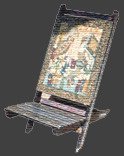
typical Kishangarhi chair
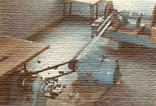
a workshop in Kishangarh
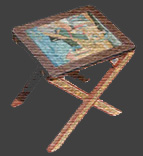
stool with
miniature painting
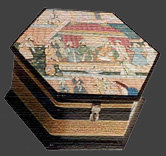
painted jewellery box
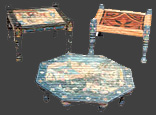
stools of different kind
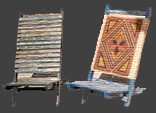
the completed chairs
|
Kishangarh has long been famous for its school of miniature painting. Most
of the furniture, as well as other crafts from this region have these Mughal style miniature painting as an integral
part of their design.
Making of craft furniture in Kishangarh has been a recent development. In fact, the manufacture of furniture for
the outside market has developed only in the last five years. The craftsmen who were previously engaged in producing
furniture for the local market have been lured by the prospects of greater profits.
By the eighteenth century, miniatures had become very popular in the Rajput states. Many of the local rulers patronised
such craftsmen and commissioned them to decorate their palaces and havelis.
Between 1755 and 1770, there was an efflorescence of artistic activity and a profusion of quality work. Bhavanidas,
a painter trained in the Mughal school in Delhi imparted knowledge to local artists under the aegis of Maharaja
Raj Singh (1706-48). Bhavanidas laid the foundation for sound craftsmanship which stood the younger generation
in good stead for years.
Before Bhavanidas, whose work was centred on portrait studies, the Kishangarh paintings mainly focused on the Lilas
of Krishna & Radha, which had been the inspiration for a significant chunk of the art. Much of the work seen
today are derived from court scenes, hunting and equestrian events, music and dance parties, festivals, illustrations
of epic and bardic love, the Ragamala theme, Brajabhasha poetry and other literary compositions (both religious
and secular).
The Place
Kishangarh, around thirty kilometres north of Ajmer is a town
with a population of around 200,000 people. It is like any other small town, with small buildings and crowded streets.
It falls on the main Ajmer — Delhi highway, and is therefore directly accessible from both places, as well as from
Jaipur. Kishangarh has a busy bus station, and a railway station.
People
The manufacture of furniture in Kishangarh falls under two broad categories. The people engaged in the actual carpentry
are from the Jangid clan, who are Brahmins, while the painters are from various castes. Both these groups are predominantly
Hindus.
While carpenters have found it easy to adapt to various designs and styles, the painters are very orthodox in nature,
and being born with the natural stubbornness of artists, are less easy to control.
All the carpenters are ardent worshippers of Vishwakarma, the god of machinery and tools. They take one holiday
a month on the day of the new moon.
The Craft
The furniture in Kishangarh is mainly of wood, though wood substitutes
are making strong inroads. Leather is also used in some places, probably influenced by nearby Tiloniya. A variety
of furniture is made here, and most are of a very simple construction, requiring a minimum of elaborate machining.
The interest element is provided by the painting on of the traditional miniature motifs of this region which gives
the furniture an unique appeal. Traditionally, the paintings were executed on silk or other fine cloth, and used
as curtains and drapery. With the boom in the market, these paintings have naturally made their mark on the furniture.
The styles of furniture are dictated by market demands. The designs are more of less standard and are derived from
designs from all over the state. The main products are dismantleable chairs, stools, chowkis, low tables, sofas,
large tables, and a variety of small boxes and containers.
Raw Material and Tools
Most of the work is of a very simple construction, requiring little more than turning, cutting and joining. The
traditional tools in use have been joined by more modern amenities. Motor driven lathes, which also double up as
sanders and grinders are used in tandem with the more conventional hammers, chisels, saws, etc. Electric saws are
also used, powered by the same motor as the lathe. Pencils, right angles, adjustable angles and markers complete
the equipment.
The raw material is locally available. The wood used is babool, shisham or aam, which can be bought cut to size
in the market. Durotuff MDF is finding increasing use as a wood substitute.
The completed furniture is first finished and then coated with Decoplast. After the desired surface is achieved,
Camel brand poster colours are used to paint the miniature, after which the final coat of Touchwood, or other polyurethane
or melamine finishes, is given.
The Market
None of the craftsmen generally sell directly to the consumer.
Middlemen are usually involved. In certain cases, entrepreneurs such as Radhike Arts have assembled a group of
over 200 craftsmen (both carpenters and painters) to work for them. Most of the painters work on the site, while
carpenters take their work home with them.
There is a lot of competition among the craftsmen, which results in sizeable undercutting, ultimately benefiting
the middleman. The middlemen involved can sell the products through their own outlets, or directly to private and
government emporia. A large amount of the produce is picked up by the RSIC, which also buys directly from the craftsmen.
Some of the dealers are planning to enter the export market.
Problems and Suggestions
As mentioned earlier, there is a lot of competition among the
local craftsmen. They borrow money to buy raw material, and after making a product, sell it to the dealers at a
very nominal profit to get ahead of the others. At times, they invest their incomes in a bottle of liquor. In this
situation, it is the middleman who ultimately benefits, a she can virtually dictate his price to the craftsman.
As yet, there is no semblance of a trade or manufacturers’ union or guild. Such an organisation would definitely
go a long way in helping the small manufacturers and craftsmen to live a better life, as they would be able to
sell their products at a reasonable rate, and not get cheated in the bargain. As the rates would be fixed, there
would be no question of undercutting. A possible advantage would be that, to sell their products, they would improve
the quality of workmanship.
Apart from that, there seems to be no other major problems. All required materials are available easily, there
is a ready buyers’ market, and most of the craftsmen have the necessary infrastructure. |